
🚀 Key Takeaways:
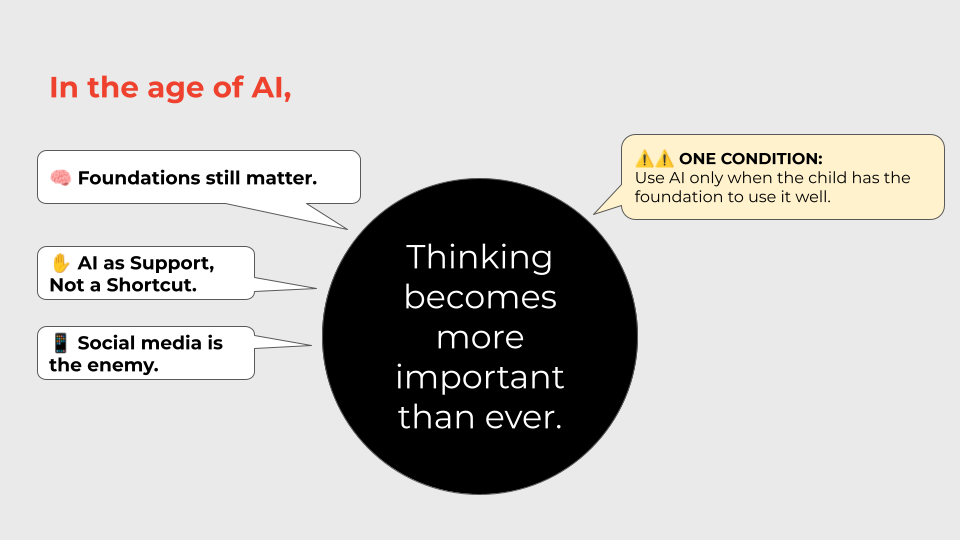
Thinking is not obsolete — it is more important than ever. AI can provide answers quickly, but children still need strong foundations to question, understand, evaluate, and apply those answers well.
AI should support learning, not replace effort. Children should think first, try, make mistakes, test, and reflect — then use AI to improve their work or get help, not simply copy and submit.
Parents should guide children from passive screen time to creative technology use. Social media and short-form videos can become “digital candy,” while coding, robotics, app development, and AI projects help children become creators, problem-solvers, and future-ready learners.
No, thinking is not becoming obsolete in the age of AI. In fact, thinking is becoming more important than ever. As artificial intelligence tools become more powerful, children need stronger foundations, better judgment, deeper problem-solving skills, and healthier digital habits.
AI can help children learn faster, generate ideas, and solve problems. But AI should not replace a child’s ability to think, question, reflect, and create.
For parents, the real question is not simply, “Can my child use AI?”
The better question is:
Does my child have the foundation to use AI well?
Why Are Parents Worried About AI and Children’s Learning?
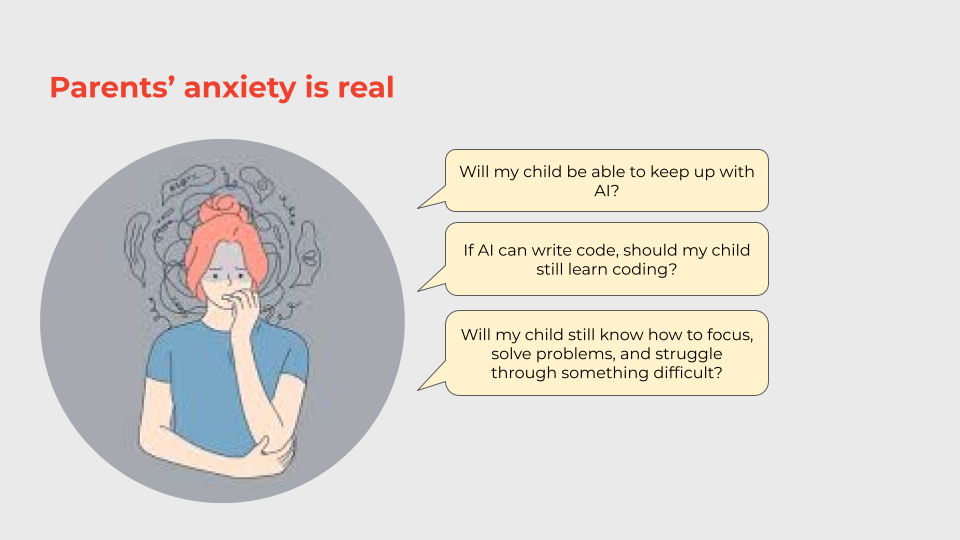
Many parents are concerned about how artificial intelligence will affect their children’s learning, focus, and future opportunities.
Common questions include:
- Will my child be able to keep up with AI?
- If AI can write code, should my child still learn coding?
- Will my child still know how to focus and solve problems?
- Will AI make my child too dependent on shortcuts?
- How can I help my child use technology wisely?
These concerns are understandable. Children today are growing up in a world where answers are instant, information is everywhere, and tools like ChatGPT can write, summarise, explain, translate, and code.
However, easy access to answers does not automatically create understanding.
Children still need to learn how to think.
Why Thinking Still Matters When AI Can Give Answers
AI can provide information, but children need thinking skills to understand, evaluate, and use that information properly.
A simple way to explain this is:
To connect the dots, the dots must be there in the first place.
Children need knowledge, vocabulary, experience, and practice before they can think deeply. These are the “dots” in their minds. When children solve problems, test ideas, make mistakes, and ask questions, they learn how to connect those dots.
Without strong foundations, a child may not know whether an AI-generated answer is correct, useful, biased, incomplete, or irrelevant.
For example:
- A child can ask AI to explain a science concept, but they still need basic knowledge to understand the explanation.
- A child can ask AI to write code, but they still need logic to know whether the code works.
- A child can ask AI to generate ideas, but they still need judgment to choose and improve those ideas.
- A child can ask AI to complete homework, but they still need understanding to learn from the task.
This is why foundational learning remains important in the age of AI.
Should Children Still Learn Coding If AI Can Write Code?
Yes, children should still learn coding even if AI can write code.
Coding is not only about becoming a programmer. Coding helps children practise logical thinking, problem-solving, creativity, resilience, and attention to detail.
When children learn coding, they learn how to:
Break a big problem into smaller steps
Think in a clear and structured way
Understand cause and effect
Test ideas
Find and fix mistakes
Stay patient when something does not work
Create something from their own imagination
In other words, coding is a form of brain training.
We do not exercise our bodies only because we want to become Olympic athletes. We exercise because our bodies need to stay healthy.
In the same way, children do not learn coding only because they want to become software engineers. They learn coding because their brains need exercise.
Coding, robotics, animation, game development, mobile app development, and AI projects all help children develop future-ready thinking skills.

What Is the Difference Between Using AI as a Shortcut and AI as a Support?
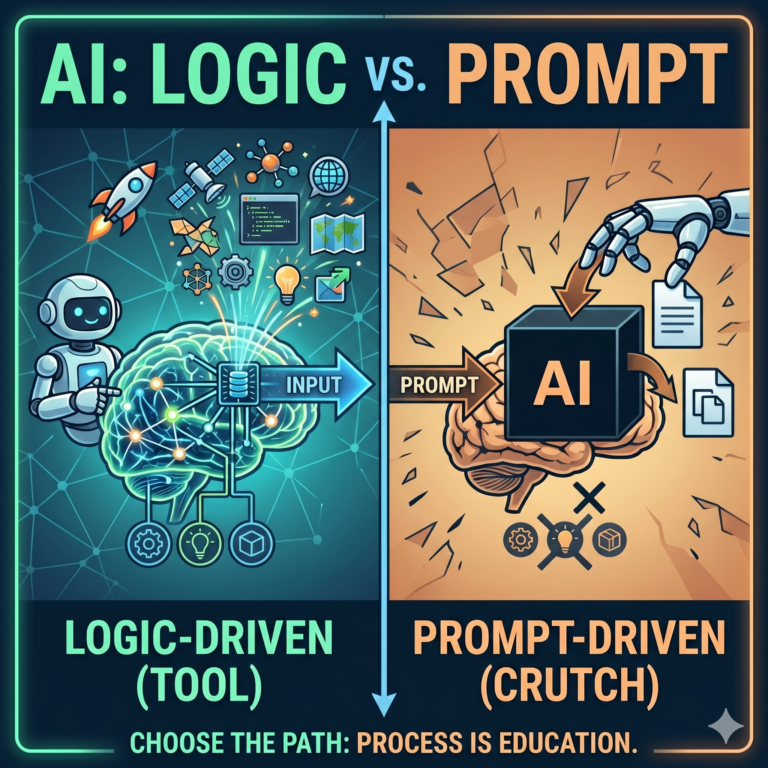
There is a major difference between using AI as a shortcut and using AI as a support.
AI as a shortcut means the child asks AI to do the work, copies the answer, and submits it without understanding. The task may be completed, but very little learning happens.
AI as a support means the child thinks first. They try to understand the problem, attempt a solution, make mistakes, test their ideas, and reflect. Then, they use AI to get feedback, improve their work, explore alternatives, or understand what went wrong.
This is the kind of AI use parents and teachers should encourage.
The goal is not for children to become dependent on AI.
The goal is for children to become better thinkers with AI.
Why Passive Screen Time Is a Bigger Problem Than AI

The real challenge is not only AI. Another major concern is passive screen time.
For many children, devices are already strongly associated with entertainment. When they see a screen, their default mode may be games, music, short videos, or social media.
Platforms such as TikTok, Instagram Reels, Facebook videos, and YouTube Shorts are designed to keep people watching. This kind of content gives quick rewards and can feel like digital candy.
It is attractive, easy to consume, and enjoyable in the moment, but it does not always nourish the mind.
This does not mean all screen time is bad.
The more important question is:
What kind of screen time is your child having?
There is a big difference between passive screen time and productive screen time.
Passive screen time includes scrolling, watching short videos, and consuming entertainment without much thinking.
Productive screen time includes coding, designing, building, researching, creating digital art, programming robots, developing games, or learning how AI works.
In the age of AI, children need more opportunities to become creators, not just consumers.
How Can Parents Help Children Build Healthy Digital Habits?
Parents do not need to become AI experts or coding teachers. But they can shape how children use technology at home.
Here are three practical steps:
1. Gain Back Control of Digital Habits
Children need boundaries around technology. This does not mean banning all devices. It means helping children understand that not all digital activities are equal.
Parents can set clear expectations around:
- Social media use
- Gaming time
- Short-form video consumption
- Online safety
- Privacy
- Age-appropriate platforms
- Device-free family time
- Sleep and screen routines
The goal is not to control every click. The goal is to help children develop self-control and healthier digital habits.
2. Ask Better Reflection Questions
Instead of only asking, “Did you finish your homework?”, parents can ask questions that encourage thinking.
Try asking:
- What did you build today?
- What problem were you trying to solve?
- What was difficult?
- What did you try first?
- What mistake did you make?
- What did you change?
- What can you improve next time?
- How did AI help you?
- What part did you still have to think through yourself?
These questions help children understand that learning is a continuous and ongoing process. They also encourage children to value effort, mistakes, and improvement.
This is especially important in coding, robotics, app development, game design, and AI learning, where things often do not work on the first try.
3. Diversify Your Child’s Exposure to Technology
Children should not only use technology for entertainment. They should also experience technology as a tool for creating, building, and solving problems.
Parents can expose children to:
- Coding
- Robotics
- Digital animation
- Game development
- Mobile app development
- Artificial intelligence
- Machine learning
- Creative computing
- Digital art and design
- Engineering challenges
- Problem-solving projects
These experiences help children discover their interests and strengths.
Over time, children can also build a portfolio of projects. A student portfolio can show creativity, persistence, problem-solving, and real-world application. It can become evidence of what a child has built, learned, and improved over the years.
Final Thought for Parents
So, is thinking becoming obsolete in the age of AI?
No! Thinking is becoming more important than ever.
AI can be a powerful learning tool, but only when children have a solid foundation to utilise it effectively. Children still need knowledge, focus, problem-solving skills, creativity, resilience, and curiosity.
Our role as parents and educators is not to prepare children to compete against AI.
Our role is to prepare children to use AI wisely.
Help children stay curious. Help them think deeply. Help them build, test, make mistakes, and try again.
Because in the age of AI, the most important skill is not simply knowing the answer.
It is knowing how to think.
FAQ: AI, Thinking Skills, and Children’s Learning
Is AI making thinking obsolete?
No. AI is not making thinking obsolete. It is making thinking more important because children need critical thinking skills to evaluate, understand, and apply AI-generated answers.
Should children still learn coding if AI can code?
Yes. Children should still learn coding because coding develops logical thinking, problem-solving, creativity, patience, and resilience. Coding is not only about producing code; it is also about training the brain to solve problems.
How should children use AI for learning?
Children should use AI as a support, not a shortcut. They should think first, try the task, make mistakes, and then use AI to get feedback, improve ideas, or understand difficult concepts.
What is the biggest risk of AI for children?
One major risk is that children may use AI to copy answers without understanding. Another risk is that children may become passive consumers of technology instead of active creators.
Is screen time bad for children?
Not all screen time is bad. Passive screen time, such as endless scrolling or short-form video consumption, is very different from productive screen time, such as coding, designing, building, researching, or creating digital projects.
How can parents help children prepare for the AI future?
Parents can help by building healthy digital habits, asking reflection questions, encouraging problem-solving, exposing children to creative technology projects, and guiding them to use AI responsibly.
What skills are most important for children in the age of AI?
Important skills include critical thinking, problem-solving, creativity, digital literacy, coding, communication, curiosity, resilience, focus, and ethical judgment.
Should parents ban AI tools?
Parents do not need to ban AI completely. Instead, they should guide children to use AI responsibly, understand its limitations, and avoid using it as a shortcut for learning.